
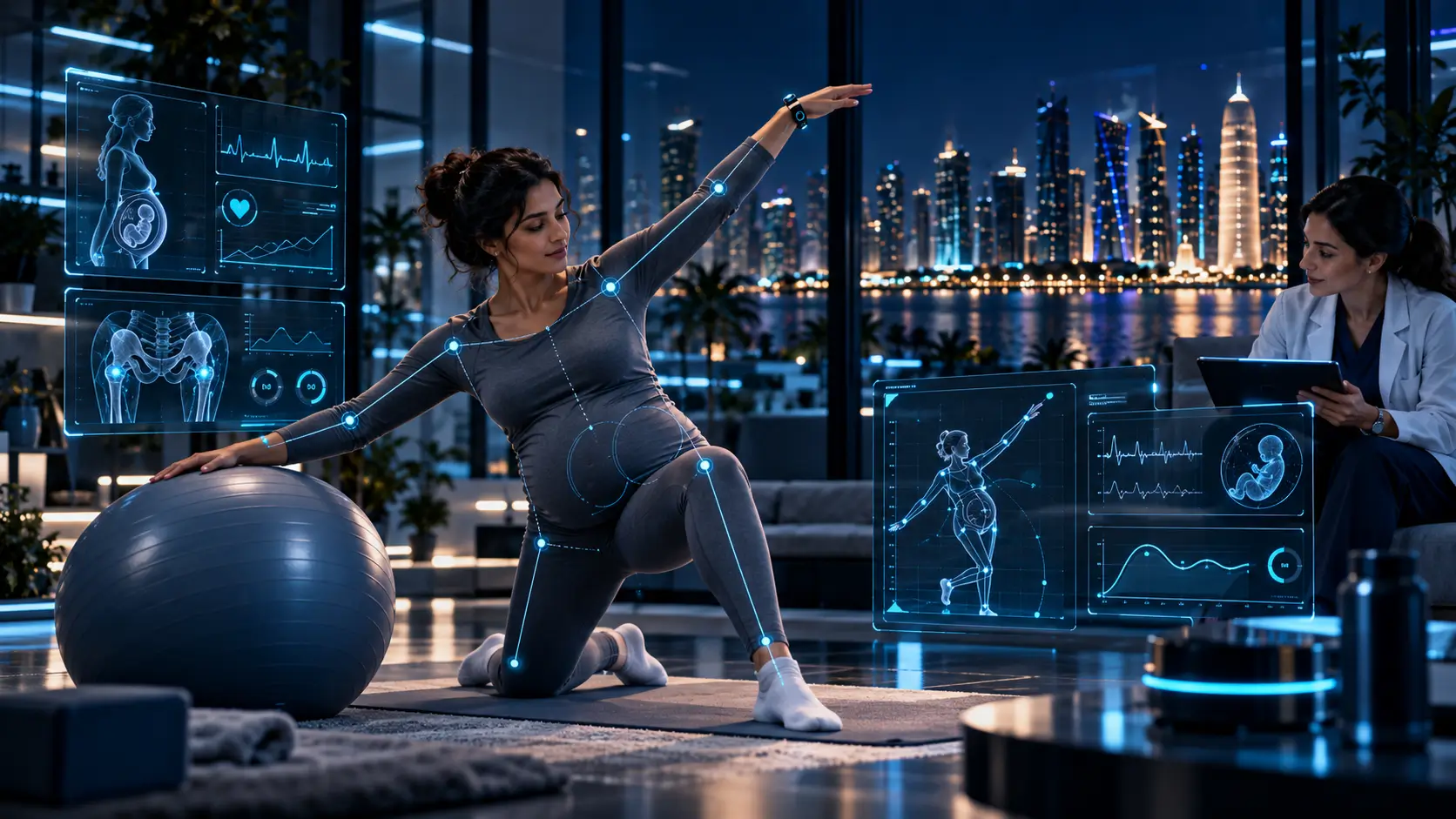
From Exercise to Insight: The Emerging Role of Technology in Maternal Health
Computer vision, wearable sensing and digital-health platforms are creating new ways to make pregnancy-related activity more measurable, visible and connected — while keeping clinical judgment where it belongs: with qualified healthcare professionals.
Pregnancy is a highly individual experience. Physical capability, clinical circumstances, comfort and wellbeing can change throughout the maternal journey.
Technology therefore has to be approached carefully. The opportunity is not to replace professional guidance with an application or algorithm. It is to explore how digital tools can help people and professionals better understand activity, movement and physiological information over time.
Pregnancy exercise begins with clinical context
The American College of Obstetricians and Gynecologists states that physical activity and exercise during pregnancy are associated with minimal risks for most women and can provide health benefits when no medical or obstetric complications or contraindications are present. [1]
Importantly, ACOG also recommends clinical evaluation before an exercise program is recommended and emphasizes that women with medical or obstetric complications require appropriate professional assessment. [1]
This creates an important boundary for maternal-health technology.
Software should not independently decide whether a particular activity is appropriate for a pregnancy. Instead, technology can potentially support a clinically informed activity plan by making movement and participation easier to observe, document and understand.
Computer vision can turn movement into information
Human movement has traditionally been assessed using professional observation or specialist measurement systems.
Modern computer-vision techniques introduce another possibility: estimating body position and movement from ordinary image or video data.
Machine-learning-based pose-estimation systems can identify key body landmarks and use those landmarks to support analysis of posture and human movement. A 2024 review of pose-estimation models describes their growing application across areas including rehabilitation, movement science, ergonomics and physical-performance analysis. [2]
In a maternal-health context, the potential value is not that a camera becomes a clinician. The value is that movement can become structured data.
Depending on the application and the quality of the underlying technology, this could help describe elements such as:
- Body position and movement patterns
- Range and consistency of movement
- Repetition patterns during prescribed activity
- Changes in posture during an exercise sequence
- Structured movement information for later review
Wearables can add physiological context
Movement tells only part of the story.
Wearable devices can capture physiological information over time and create data streams that are different from the occasional measurements collected during traditional appointments.
A 2024 study published in npj Digital Medicine examined biometric data recorded across complete pregnancies using wearable devices. The work demonstrates the research potential of continuous physiological measurement throughout pregnancy and highlights how longitudinal data may reveal changes that are difficult to observe through infrequent measurements alone. [3]
This does not mean that consumer wearables should replace clinical monitoring.
Their potential value lies in adding another layer of context — especially when data is interpreted cautiously, transparently and within an appropriate professional workflow.
The bigger opportunity is connecting the information
A computer-vision algorithm by itself is not a maternal-health platform.
A wearable by itself is not a maternal-health platform either.
The more interesting opportunity appears when different forms of information can be brought together responsibly.
A connected workflow may involve:
- A clinically appropriate exercise or activity plan
- Computer-vision-based movement measurement
- Selected wearable or physiological information
- A mobile application that organizes the experience
- Structured summaries for professional review
The important layer is not simply the number of sensors involved. It is how information moves between the woman, the technology and the professionals responsible for her care.
More data does not automatically mean better care
Digital-health products can generate large amounts of information. That creates both opportunity and responsibility.
A useful maternal-health system needs to determine what information genuinely contributes to the intended purpose.
Product teams therefore need to ask:
- Which measurements are meaningful?
- How accurate and reliable are they?
- What information actually needs to be stored?
- Who should have access?
- How should uncertainty be communicated?
- When should a professional review the information?
These are not secondary implementation questions. They are part of the product architecture itself.
Maternal technology should remain human-centered
Pregnancy is not simply a collection of metrics.
Any digital system operating in maternal health needs to recognize that experience, confidence, comfort and communication also matter.
The goal should not be to turn every movement into a warning or every physiological change into an alert.
Technology should reduce uncertainty where it can, improve visibility where it is useful and support better communication without creating unnecessary anxiety or implying certainty that the underlying data cannot provide.
From movement to meaningful insight.
At Smart Life Solutions Group, we see maternal health as an important example of why intelligent technology needs to be designed around real human workflows.
This thinking informs the development direction represented by AvinaMama — exploring how computer vision, wearable monitoring and structured reporting can work together within a more connected maternal-health experience.
The objective is not to create another generic pregnancy fitness application.
The opportunity is to make clinically guided activity more measurable, improve the organization of relevant information and strengthen the connection between the person performing an activity and the professional responsible for her care.
Technology is most valuable when it helps turn activity into useful information — without losing sight of the human experience behind the data.
View ACOG Source →
View PubMed Source →
View Nature Source →