
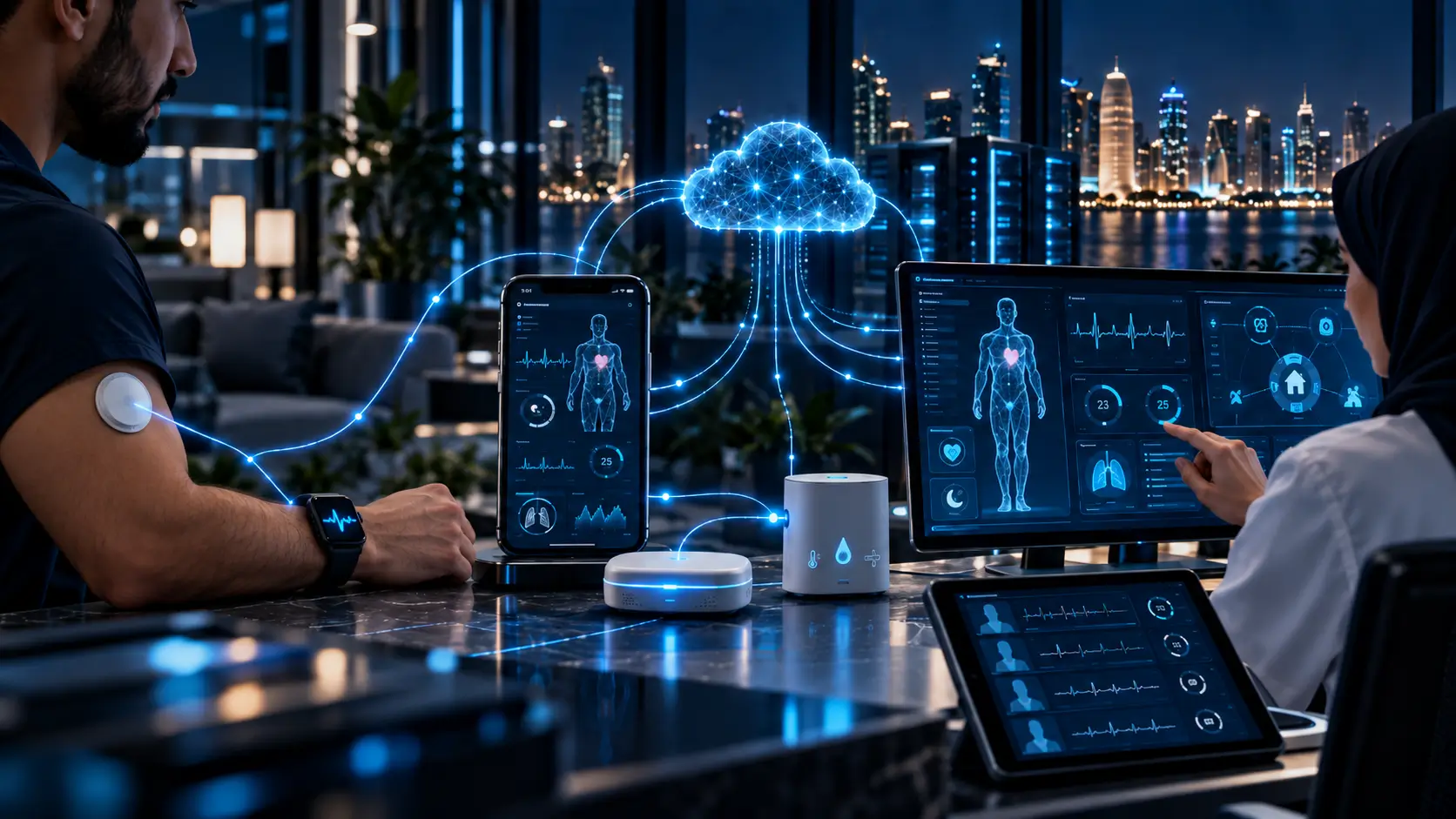
Beyond the Device: Why Connected Health Depends on the Whole System
A wearable, sensor or smart device becomes truly useful only when data, software, connectivity, security and human workflows work together as one connected system.
The most visible part of connected technology is usually the device.
A smartwatch. A wearable sensor. An environmental monitor. A camera. A connected medical device.
But the device is only one layer of a much larger architecture.
The real value of connected health emerges from what happens after information is sensed: how that information is transmitted, processed, organized, protected, interpreted and ultimately presented to the person responsible for acting on it.
A sensor is the beginning, not the solution
Modern wireless healthcare monitoring systems commonly involve multiple components working together.
A 2024 review published in IEEE Access describes healthcare monitoring architectures involving wearable sensors and hardware devices, intelligent data collection and processing, and network connectivity. [1]
This matters because an individual sensor cannot provide value in isolation.
A heart-rate sensor, for example, still requires software to receive its output, a communication layer to move information, logic to organize the data and an interface that allows someone to make appropriate use of it.
That is why connected-system development should begin with the intended purpose rather than with the hardware catalogue.
Connected health is a system of layers
A practical connected-health architecture can involve several distinct layers.
The first layer senses something. Depending on the intended application, that might include movement, temperature, heart rate, environmental conditions or another physiological or behavioral signal.
The next layer handles connectivity. Information may move through Bluetooth, Wi-Fi, cellular networks or another appropriate communication technology.
Software then receives, stores and organizes the information.
Analytics or AI may help identify patterns, prioritize information or support interpretation.
Finally, an interface delivers relevant information to someone who can use it.
Depending on the system, that person might be:
- The individual using the technology
- A healthcare professional
- A caregiver or family member
- An authorized monitoring team
- An institutional administrator
If one layer fails, the usefulness of the entire connected system can be affected.
Interoperability is what turns connection into usefulness
Connecting devices physically or wirelessly is not the same as making them interoperable.
The U.S. Food and Drug Administration defines medical-device interoperability as the ability to safely, securely and effectively exchange and use information among devices, products, technologies or systems. [2]
That exchanged information may then be displayed, stored, interpreted, analyzed or used by another system.
This is a critical distinction.
If multiple devices generate useful data but their information cannot move between systems in a reliable and understandable way, the overall experience remains fragmented.
Good connected-system architecture therefore needs to consider areas such as:
- Data formats and interfaces
- APIs and integration points
- Device identity and authentication
- Reliable communication between components
- Error handling when a connection fails
- Clear ownership of data and system responsibilities
More connected devices do not automatically create better intelligence
Connected technology makes it technically possible to generate enormous amounts of information.
But collecting more data is not the same as generating more useful insight.
A well-designed system needs to determine which signals actually contribute to its intended purpose.
Product teams therefore need to make deliberate decisions about questions such as:
- What information genuinely needs to be collected?
- How frequently should it be measured?
- What level of precision is necessary?
- Where should processing occur?
- How long should information be retained?
- Who should be able to access it?
- What happens if a sensor disconnects or sends unreliable data?
These decisions influence not only performance, but also privacy, cost, reliability and the overall usability of the system.
Every new connection also creates responsibility
Connectivity creates convenience and new capabilities, but it also expands the surface that needs to be secured.
The FDA notes that modern medical devices are increasingly connected to the internet, hospital networks and other medical devices. Those connections can improve functionality, but they can also introduce cybersecurity risks. [3]
For connected-health technology, cybersecurity therefore cannot be treated as a feature that is added after product development is complete.
Security considerations may include:
- Device and user authentication
- Encryption of information in transit and at rest
- Secure software updates
- Management of vulnerabilities over the product lifecycle
- Access controls and permissions
- Monitoring for unexpected system behavior
- Clear recovery procedures when something fails
In health-related environments, cybersecurity is ultimately connected to trust and, depending on the system, potentially to safety as well.
The final layer is still human
Connected technology can sense, transmit, process and visualize information.
But eventually that information needs to become useful to a person.
A technically impressive dashboard may still fail if it overwhelms users with alerts.
A sophisticated wearable may provide little practical value if people cannot understand what its information means.
A monitoring system may generate accurate data, but still create friction if it does not fit the responsibilities and routines of the people expected to use it.
This is why connected-health architecture should be designed around human workflows as much as technical infrastructure.
The goal is not to create the largest possible stream of data.
The goal is to deliver useful information to the right person, at the right moment, in a form that supports an appropriate action.
Whole-system thinking changes how products are built
Once connected health is viewed as a system rather than a collection of gadgets, product-development priorities begin to change.
Hardware remains important, but so do software, APIs, cloud or local infrastructure, cybersecurity, user experience, data governance and long-term maintainability.
The value of the product becomes the quality of the entire chain:
- Sense the right information
- Move it reliably
- Process it appropriately
- Protect it responsibly
- Present it clearly
- Support a useful human workflow
This is what transforms a connected device from an isolated piece of hardware into part of an intelligent technology system.
Intelligence lives in the system, not the device.
At Smart Life Solutions Group, we do not view IoT as a collection of connected gadgets.
We approach connected technology as an integrated architecture in which devices, sensors, software, data, AI and user interfaces need to work together around a clearly defined real-world purpose.
This systems-thinking approach informs our work across digital health, intelligent monitoring, connected environments and the broader technology foundation represented by SynapseCore.
The objective is not simply to make more things connected.
It is to create connected systems that make information more useful, workflows more responsive and technology more meaningful to the people who depend on it.
View IEEE Source →
View FDA Source →
View FDA Source →